Deutsch
Metaverse is a term that has received a lot of attention since 2021 and has significantly lost momentum since 2023. But what truly lies behind this concept? And what does the Metaverse have to do with blockchain?
The Metaverse is more than just a technological trend. It is a vision that aims to reinvent the way we experience the internet and the digital world. The idea: to blur the lines between reality and the virtual world by allowing users to immerse themselves in an immersive and interactive online environment. How far this vision truly extends and what remains of the hype will become much clearer in 2026 than it was three years ago.
In this article, we take a closer look at what the Metaverse is, how it has developed, and where it truly stands today. We explain how the technology behind the idea works, what it is already used for, and how it is connected to blockchain technology and cryptocurrencies.
What is the Metaverse? Definition & Explanation
The term “Metaverse” originally comes from Neal Stephenson’s 1992 science fiction novel “Snow Crash.” The Metaverse is a virtual universe that offers an immersive and interconnected digital reality. When immersing oneself in the experience, one is not just a passive observer but feels as if one is actually present in the virtual world. The Metaverse goes beyond previous virtual reality experiences with VR headsets, creating platforms, enabling social interactions, and diverse digital worlds that can be experienced.
Users each create an avatar that represents them in the virtual world. With it, it is possible to move through different areas of the Metaverse and engage in real-time interactions. The basic idea of the Metaverse is to create a seamless connection between the physical and digital worlds.
The Metaverse promises to change the way we interact, work, learn, and play. Online shopping, entertainment, social connections – in short, everything we do should be possible on a virtual and digital level.
Even if the name might suggest it, Meta is not the founder of the Metaverse. Rather, it is a concept that is being further developed and created by a variety of actors.
The Technology Behind the Metaverse: How Does the Digital World Work?
The idea of the Metaverse works through the combination of several different technologies. So let’s look at what each contributes to the overall concept.
VR headsets (Virtual Reality) allow users to immerse themselves visually and partly audibly into virtual worlds. This creates a 3D environmental experience. Currently, the most common devices include the Meta Quest 3 and 3S, as well as the Apple Vision Pro, released in 2024. AR headsets (Augmented Reality) are similar to VR headsets. However, instead of diving into a completely digital world, AR extends the real environment with virtual elements. This creates a kind of overlap between the virtual, digital, and real worlds. A lighter variant is smart glasses like the Ray-Ban Meta, which established themselves as one of the most commercially successful products in this category in 2026.
Sensors and the Internet of Things (IoT) contribute to collecting data from the real world and creating a dynamic and rich environment in the Metaverse. Computationally intensive tasks such as generating 3D graphics or processing large amounts of data are often performed in the cloud. Cloud computing is therefore crucial for creating a smooth experience.
The blockchain technology forms the technical backbone for many components of the Metaverse. For example, with smart contracts. These enable the secure exchange of virtual goods and services. Cryptocurrencies are used as a means of payment, for the representation of digital assets (NFT), as in-game currency, as a basis for DeFi contracts (Decentralized Finance), or for social interactions and rewards.
Last but not least, the Metaverse thrives on social interaction. Artificial intelligence (AI) is used to create so-called NPCs (non-playable characters) that act in the virtual world. AI is also used to create personalized content and recommendations based on user data. With the rise of generative AI since 2023, applications such as the automatic creation of 3D assets, avatars, or real-time translations within virtual worlds are increasingly being added.
Metaverse and Cryptocurrencies: Connections and Use Cases
<p”>Cryptocurrencies and blockchain form the economic foundation of many metaverse projects. Through tokenization, digital assets in the Metaverse become verifiable and tradable. For example, with an NFT, which proves real ownership of virtual land, an object, or even a character. These assets can then also be traded outside the Metaverse. Playing Play-to-Earn games, creating content, or trading digital goods opens up new opportunities for crypto investors.
The specific use cases can be divided into three main areas:
- Gaming
- Virtual Real Estate
- Art and Culture
In the gaming sector, The Sandbox is a prominent example. In this Metaverse game, you interact with a character similar to a Minecraft character. On a huge map, you can explore various areas. For example, for zombie game fans, there is the region The Walking Dead, named and inspired by the comic book of the same name.
In the virtual real estate sector, users can purchase virtual plots of land in the digital world of the Decentraland project. They can then manage or develop these plots. For example, there is a virtual Nike store where you can view and purchase products. Each of the total 90,601 parcels has a size of 16 by 16 meters (256 square meters) and is represented by a Non-Fungible ERC-721 Token (NFT). With the help of the NFT, plots of land can be traded.
In the field of art and culture, artists have also found new ways to present themselves digitally. Virtual galleries, exhibitions, and events exist in the Metaverse. Additionally, this form of exhibition offers artists and viewers a new way to experience art interactively. For example, in teamLab’s project “The World’s First Digital Art Museum,” there is art that reacts in real-time to visitors’ movements, making the connection between art and viewer tangible in a new way.
The 3 Best Metaverse Coins 2026
Which is the best Metaverse coin can be a very subjective matter. Below you will find the three most important Metaverse coins of recent years, which will continue to be among the established projects in 2026.
Decentraland (MANA)
Decentraland is one of the oldest and best-known Metaverse platforms and runs on the Ethereum blockchain. Users can buy, build on, and trade virtual land, create their own avatars, and participate in events or decentralized votes via the Decentraland DAO. The platform uses two tokens: MANA as an ERC-20 payment method and LAND as an NFT representing virtual land ownership.
Brands like Samsung, JPMorgan, and Sotheby’s have previously established their own presences in Decentraland. As of April 2026, MANA is trading at around $0.09 to $0.20 – about 95 to 98 percent below its all-time high of 2021.
The Sandbox (SAND)
The Sandbox is a Metaverse game where you interact with a character similar to a Minecraft character. On a huge map, you can explore various areas, own virtual plots of land (LANDs), and create your own gaming experiences. The SAND token is the central currency of the ecosystem and is used for transactions, governance, and rewards.
In 2025, the project was restructured under the leadership of Animoca Brands, with more than half of its approximately 250 employees being laid off. As of April 2026, SAND is trading below $0.20, which is about 95 percent below its all-time high of 2021.
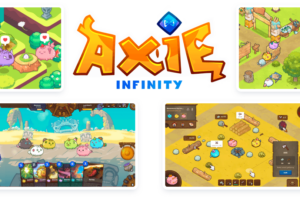
Axie Infinity (AXS)
Axie Infinity is an online game built on blockchain technology. The game developed by Sky Mavis uses Non-Fungible Tokens (NFTs) to represent so-called Axies (virtual creatures). These can be bought, exchanged, and traded by users. With the help of the NFT, which are unique and one-of-a-kind, ownership of the virtual creature can be proven. As part of the game, you can pit your Axies against those of other players.
Axie Infinity is one of the pioneers of the Play-to-Earn model and reached its peak in 2021 with over 2 million daily players. Since then, user numbers have significantly declined. As of April 2026, AXS is trading at around $1 to $1.20. That’s 99 percent below its all-time high of $165 in November 2021.
Opportunities and Challenges for Cryptocurrencies in the Metaverse
The Metaverse offers crypto investors a multitude of opportunities, but also presents society with at least as many challenges.
By purchasing Metaverse tokens, one can invest directly in a project. The value of this token can increase if the demand for the Metaverse and corresponding projects rises.
Similar to the real estate market, investors can buy and own virtual land in the Metaverse. Here too, investors can profit if the demand for the virtual asset increases. It is also possible to create and sell new goods, such as virtual artworks, in the Metaverse. This also includes providers of Metaverse platforms and services.
However, the risk should not be underestimated: The development of the Metaverse sector since 2022 has shown that the services and goods offered were not in demand to the originally expected extent. Many projects had to lay off employees, token prices plummeted, and public interest shifted towards AI.
The Metaverse is, by definition, interoperable and open. This also means that users can operate across borders. This, in turn, presents the concept with several challenges. Among other things, the question of regulation and compliance for crypto used in the Metaverse must be clarified. Currently, there are few uniform standards, and each country has its own regulations.
Topics that also need to be discussed and clarified include the handling of personal data that is collected. But also the safeguarding of intellectual property, liability, youth protection, competition law, tax regulation of cryptocurrencies in the Metaverse, and international cooperation must be regulated. Last but not least, there are societal concerns regarding social isolation and the addictive potential of intense virtual experiences.
Is the Metaverse Dead?
The hype of 2021 and 2022 is over. Meta’s Reality Labs division has accumulated approximately $83.6 billion in operating losses since 2020, with $19.1 billion in 2025 alone against $2.2 billion in revenue. From Q3 2024, Meta almost completely avoided the term “Metaverse” in earnings calls. The focus shifted instead to AI and smart glasses like the Ray-Ban Meta.
Crypto Metaverse projects have also significantly shrunk. MANA is trading in 2026 about 98 percent below its all-time high, The Sandbox was restructured under Animoca Brands and laid off more than half of its 250 employees. The daily active users of Decentraland are in the low four-digit range. Other games like Roblox and Fortnite reach millions.
What remains are sub-areas: VR hardware like Meta Quest 3 and Apple Vision Pro has established itself as a product category, enterprise VR is used for training in medicine and industry, and VR gaming is a functioning niche, albeit without a blockchain component. The Metaverse as a unified, interoperable virtual world with mass adoption has failed in its original vision.
Conclusion: What You Should Know About the Metaverse
The Metaverse is a concept that gained a lot of attention starting in 2021 and has since had to undergo a more realistic assessment. It aimed to enable a connected online experience and immerse users in a virtual reality that goes beyond simple VR experiences. This gives one the feeling of not being a passive observer of something, but actually being in the digital environment. Social interactions, as well as experiencing and designing digital worlds, are made possible.
Metaverse technology is based on VR and AR headsets, sensors, IoT, cloud computing, and blockchain. These technologies make it possible to create immersive environments, tokenize virtual goods, and use smart contracts for automated transactions. Cryptocurrencies play a crucial role as a means of payment, representation of digital assets, and in-game currency.
The Metaverse finds application in crypto gaming, real estate, art, and culture. It offers investors new opportunities but also entails challenges regarding regulation, data protection, and international cooperation. Developments since 2023 have shown that the original vision of a unified, interoperable Metaverse with mass adoption has not materialized. What remains are specific applications in gaming, enterprise training, and hardware, as well as a significantly cooled but still existing crypto-Metaverse sector. For investors, this means: opportunities still exist, but only with a realistic assessment of the current status and the longer time horizons that would be necessary for a potential revival.
Frequently Asked Questions about the Metaverse
- How Can I Invest in Metaverse Coins?
Crypto metaverse projects each have their own coin or token. You can find Metaverse coins and tokens like MANA, SAND, AXS, etc. on the common crypto exchanges. There you can buy and trade them. Always remember to research the project and its usefulness before making any investment and only invest as much as you are willing to lose.
- How Can I Use My Cryptocurrencies in the Metaverse?
The ways you can use your cryptocurrency in the Metaverse are diverse and depend on the specific platform or service offered. Examples include buying virtual land or real estate, acquiring digital art or virtual items for your character in a game, and participating in virtual concerts, events, or parties.
- Which Crypto Projects are Already Active in the Metaverse?
Among the multitude of projects already launched, the largest include Decentraland (MANA), The Sandbox (SAND), Axie Infinity (AXS), and ENJ (Enjin Coin).