Deutsch
At first glance, the crypto market appears more stable than at the beginning of the year. Bitcoin has recovered after significant pullbacks, individual altcoins repeatedly show short-term strength, and institutional topics like ETFs remain present. However, beneath the surface, a different picture emerges: trading volume on crypto exchanges has massively declined.
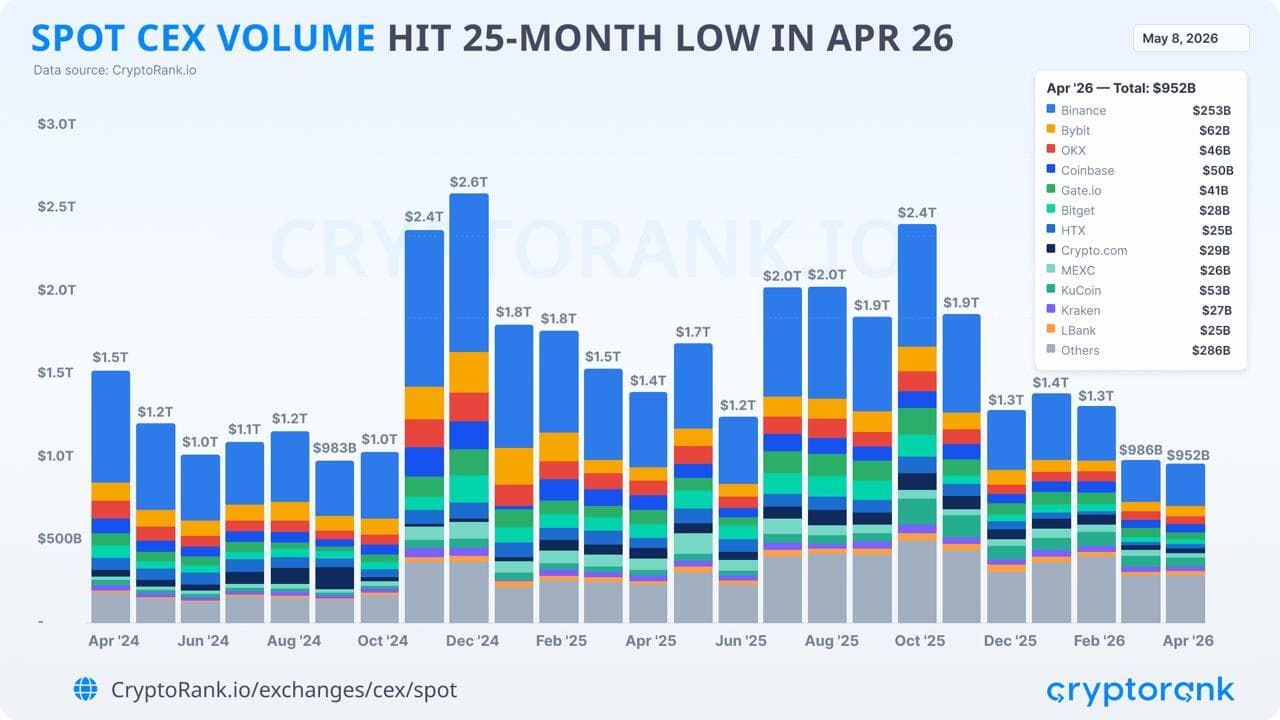
According to a recent analysis by CryptoRank, spot trading volume on centralized crypto exchanges fell to $951.8 billion in April 2026. This represents the lowest level in 25 months. Compared to March, the decline was 3.5 percent, and compared to the peak in December 2024, it was even 63 percent.
This raises an important question: Is the crypto market merely quiet, or does it currently lack the strength for a sustained rally?
Spot Trading Falls to 25-Month Low
The cooling-off is particularly evident in classic spot trading. Here, investors directly buy and sell cryptocurrencies, such as Bitcoin, Ethereum, or Solana. Precisely this area is often considered an important indicator of genuine market demand because it is less influenced by leveraged products and short-term derivative trades.
CryptoRank estimates the centralized spot trading volume in April 2026 at $951.8 billion. This is not only less than in March but also the lowest monthly value in over two years. At the same time, the volume is significantly below the December 2024 peak of $2.6 trillion.
Other tracking platforms like CoinGecko had already noted significant weakness for the first quarter of 2026. According to them, the spot trading volume of the ten largest centralized exchanges fell by 39.1 percent to $2.7 trillion in the first quarter. March was the weakest month since November 2023, with approximately $0.8 trillion.
This shows: the decline in April is not an isolated event. It fits a longer-term trend of decreasing trading activity.
Binance Remains Dominant, Coinbase Catches Up
Despite the weak overall market, Binance remains the clear number one in spot trading. According to CryptoRank, Binance achieved a monthly spot volume of $252.6 billion in April, accounting for a market share of 26.5 percent. The platform thus remained about four times larger than its closest competitor.
However, the movement behind it is interesting. In April, Coinbase re-entered the global top 4 spot exchanges for the first time in over a year, surpassing OKX. According to CryptoRank, Coinbase recorded $50.4 billion in spot volume and a market share of 5.3 percent.
This is relevant for the market because Coinbase is strongly associated with regulated markets and US investors. A better ranking for Coinbase may indicate that regulated trading venues are gaining relative importance despite declining overall activity.
Futures Also Collapse
Not only is the spot market losing momentum. Futures trading has also significantly weakened. According to CryptoRank, futures volume fell to $5.0 trillion in April 2026. This was the lowest monthly value since October 2024 and a 9.6 percent decrease compared to March.
The difference from the spot market is important. Futures are often used by professional traders, market makers, and speculative market participants. If volume also declines there, it indicates broader caution.
After the record high of $10.9 trillion in October 2025, futures activity sharply declined. CryptoRank points to declines of 22 percent in November and another 28 percent in December. Since then, monthly declines have slowed, but the activity level remains significantly lower than during the rally in the fourth quarter of 2025.
Perp DEXs Also Lose Volume
Decentralized perpetual exchanges, known as Perp DEXs, are also not spared from the decline. According to CryptoRank, trading volume fell to $518 billion in April. This was the sixth consecutive monthly decline since the peak in October 2025. Compared to March, the decrease was 3 percent.
Nevertheless, a structurally exciting trend is emerging in this segment. According to CryptoRank, the market share of Perp DEXs in total trading volume has increased from 2.9 percent in April 2024 to 8.0 percent in April 2026. This means the share has almost tripled within two years.
This means: even if absolute volumes are decreasing, decentralized derivatives platforms are gaining relative importance. Hyperliquid, in particular, dominates this area. In April, Hyperliquid recorded $186 billion in monthly volume, accounting for almost 36 percent of the total on-chain perpetual trading, according to CryptoRank.
What Does Low Trading Volume Mean?
Low trading volume is not automatically negative. It can also mean that the market is calming down after a strong movement. Periods of consolidation, with less trading and new trends preparing, often follow phases of exuberance.
Nevertheless, the current decline is an important warning sign. Rising prices with simultaneously falling volume are often considered less stable because fewer market participants are driving the movement. Without broad participation, prices can reverse more quickly.
This is precisely where the central tension in the market lies. On the one hand, there are still strong narratives around Bitcoin ETFs, institutional demand, and long-term adoption. On the other hand, trading data shows that many investors and traders are currently acting more cautiously.
CoinGecko already described the first quarter of 2026 as a phase of weak market activity. The total crypto market capitalization fell by 20.4 percent to $2.4 trillion in the first quarter, while the average daily trading volume decreased by 27.2 percent.
Conclusion: The Crypto Market Needs Real Activity Again
The current data paints a clear picture: trading volume on crypto exchanges has fallen sharply. Spot trading on centralized exchanges reached a 25-month low in April, futures fell to their lowest level since October 2024, and Perp DEXs also recorded their sixth consecutive monthly decline. Thus, the market is at an important juncture. While the prices of individual cryptocurrencies may recover, any rally remains more fragile without increasing volume.
At the same time, an important shift is evident: while activity on traditional crypto exchanges is declining, ETF inflows and institutional purchases continue to gain importance. A larger portion of demand is therefore no longer generated directly through spot trading on exchanges, but through regulated financial products, funds, and professional market participants.
For the next sustained uptrend, the crypto market therefore needs more than good headlines. It will be crucial whether, in addition to ETF and institutional demand, broad trading activity also returns for Bitcoin, Ethereum, altcoins, and on the major exchanges.
More news about Bitcoin