Deutsch
Bitcoin Runes have expanded the functionality of the Bitcoin blockchain. In this article, you will learn what’s behind the protocol, how it differs from Ordinals and BRC-20, and what role it plays in the BTC ecosystem today.

Bitvavo, one of the leading exchanges from Europe (Netherlands) with a large selection of cryptocurrencies. PayPal deposit possible. Limited time offer: €20 bonus when you sign up via CoinPro.ch
What are Bitcoin Runes?
Bitcoin Runes is a protocol that allows for the creation of fungible tokens directly on the Bitcoin blockchain. The person behind the development is none other than the well-known programmer Casey Rodarmor.
Rodarmor is a former Bitcoin Core developer—the key software behind the Bitcoin blockchain. He eventually left that work and devoted himself to his own projects. Still, he remained loyal to Bitcoin.
The developer gained significant attention in early 2023 when he released the Ordinals protocol. In the spring of 2023, the euphoria surrounding Ordinals drove the Bitcoin price up and became the biggest trend involving the blockchain at the time.
The American followed up on this success with Runes. Using typical industry jargon, he described his new protocol as being geared toward “degenerates and memecoins.” It allows users to create their own tokens modeled after the ERC-20 standard on Ethereum.
Runes is software, not a cryptocurrency. Therefore, a direct investment in the technology itself is not possible. Users should not be fooled by coins available under the same name.
The protocol does not use any data located outside the blockchain. A transfer via the Lightning Network is therefore also possible.
Bitcoin Runes in Comparison
When discussing Bitcoin Runes, comparisons are often made with the BRC-20 token standard as well as Bitcoin Ordinals. But what are the differences?
Bitcoin Runes vs. BRC-20
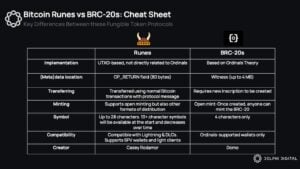
Rodarmor recognized the need for Runes through the emergence of the BRC-20 standard. This token type builds on Rodarmor’s Ordinals protocol and caused a major stir in 2023. However, BRC-20 was less than optimal due to how Ordinals functions. Runes eliminates these existing weaknesses. The protocol is written from scratch and is not based on Ordinals.
Since Runes focuses on the creation of fungible tokens, it is significantly simpler than Ordinals. It offers users more convenience. At the same time, it can be deployed more cost-effectively.
To transfer a BRC-20 token, three transactions are required due to how Ordinals works. Two transactions are needed to create these inscriptions, and one to transfer the resulting inscription to the recipient.
To create Runes, users need to make two transactions. After creation, however, only one transaction is needed for a simple token transfer.
Another important advantage: Runes produces significantly fewer so-called “junk UTXOs.” These are superfluous transaction remnants that burden the Bitcoin network. BRC-20 generates a particularly high number of these, which can lead to congestion and higher fees. Runes bypasses this problem by storing token balances directly in the UTXOs.
This is also reflected in market dynamics: Runes has now significantly overtaken BRC-20 as the dominant token standard on Bitcoin. In addition to Runes, the ORC-20 standard also attempted to address the BRC-20 weaknesses. Ultimately, however, Runes prevailed, finding greater traction due to the authority of the Ordinals creator and a well-thought-out UTXO design.
Bitcoin Runes vs. Bitcoin Ordinals
How do Bitcoin Runes and Bitcoin Ordinals differ? While both protocols come from the same developer, they pursue opposite goals:
Ordinals was designed to create non-fungible digital content on Bitcoin. These are unique artifacts, comparable to NFTs. Data is inscribed directly onto individual satoshis (so-called inscriptions).
Runes does the exact opposite: fungible tokens where every unit is identical and interchangeable. It is therefore more comparable to a currency or an ERC-20 token. Instead of inscribing data on satoshis, Runes uses Bitcoin’s UTXO (Unspent Transaction Output) model and stores token information in the OP_RETURN field of a transaction.
The practical difference: Ordinals are suitable for art, collectibles, and digital artifacts. Runes are suitable for memecoins, utility tokens, or anything intended to circulate in large, identical quantities.
Bitcoin Runes: Marketplaces & Current Status 2026
After the euphoric launch, the Runes ecosystem has entered a quieter phase. The share of Runes transactions on the Bitcoin network fell from over 50% at its peak to under 2%. This is less dramatic than it sounds, as the early figures were clearly driven by speculative hype.
A noticeable turning point was the withdrawal of Magic Eden. On February 27, 2026, CEO Jack Lu announced the complete closure of the Bitcoin Ordinals, Runes, and EVM NFT marketplaces. Trading ended on March 9, 2026, and the wallet will go offline on April 1, 2026. The company will henceforth focus on Solana and a new iGaming product.
The exit has triggered a consolidation in the market. The most important platforms for Bitcoin Runes today are:
- OKX: The crypto exchange integrates Runes directly into its wallet and marketplace, positioning itself alongside Unisat as the main alternative to Magic Eden.
- Unisat: The pioneer service for Bitcoin tokens offers etching, minting, a marketplace, and Runes management. Unisat has clearly stated its intention to remain in the market long-term.
- Xverse: The wallet aggregates liquidity from various sources and allows for swaps directly from the app.
- DotSwap: An AMM-based swap protocol for Runes trading.
To perform transactions with the token standard, the user must use a wallet that supports it. Xverse, Unisat, and the OKX Wallet are among the established options.
Tokens created by Runes can become targets of heavy speculation. Volatility is often extreme, especially with novel assets. Users should therefore exercise caution with their investments. If demand is low, a total loss cannot be avoided, particularly with tokens that have no underlying function.
Criticism and Outlook
In his Twitter announcement, Rodarmor mentioned that Runes was a serious competitor to RGB and Taproot Assets. Both projects also aim to allow users to create their own tokens on Bitcoin.
“I’m very skeptical that any serious tokens will come out of this, but Runes is without a doubt a serious token protocol,” Rodarmor wrote on Twitter.
Nevertheless, he considers the protocol itself to be more of a gimmick. However, the potential impact on Bitcoin should not be underestimated. In 2023, Ordinals led to heated debates that have flared up again with Runes.
This approach already drew harsh criticism in 2023. Critics consider this use of the OP_RETURN function to be abusive, as it was not originally intended for storing entire token ecosystems.
Critics also repeatedly point to an unnecessary bloating of the Bitcoin blockchain. Proponents argue otherwise: higher transaction fees from Runes activity are a welcome incentive for miners—especially after a halving, when block rewards are cut in half.
The future of the protocol depends less on the technology itself—which works—than on whether sustainable use cases establish themselves beyond memecoins. Tokenized loyalty programs, stablecoins on Bitcoin, or liquidity building blocks for BTCFi are conceivable directions. As long as the vast majority of Runes remain purely speculative, the protocol will keep its niche but is unlikely to become a mass phenomenon.